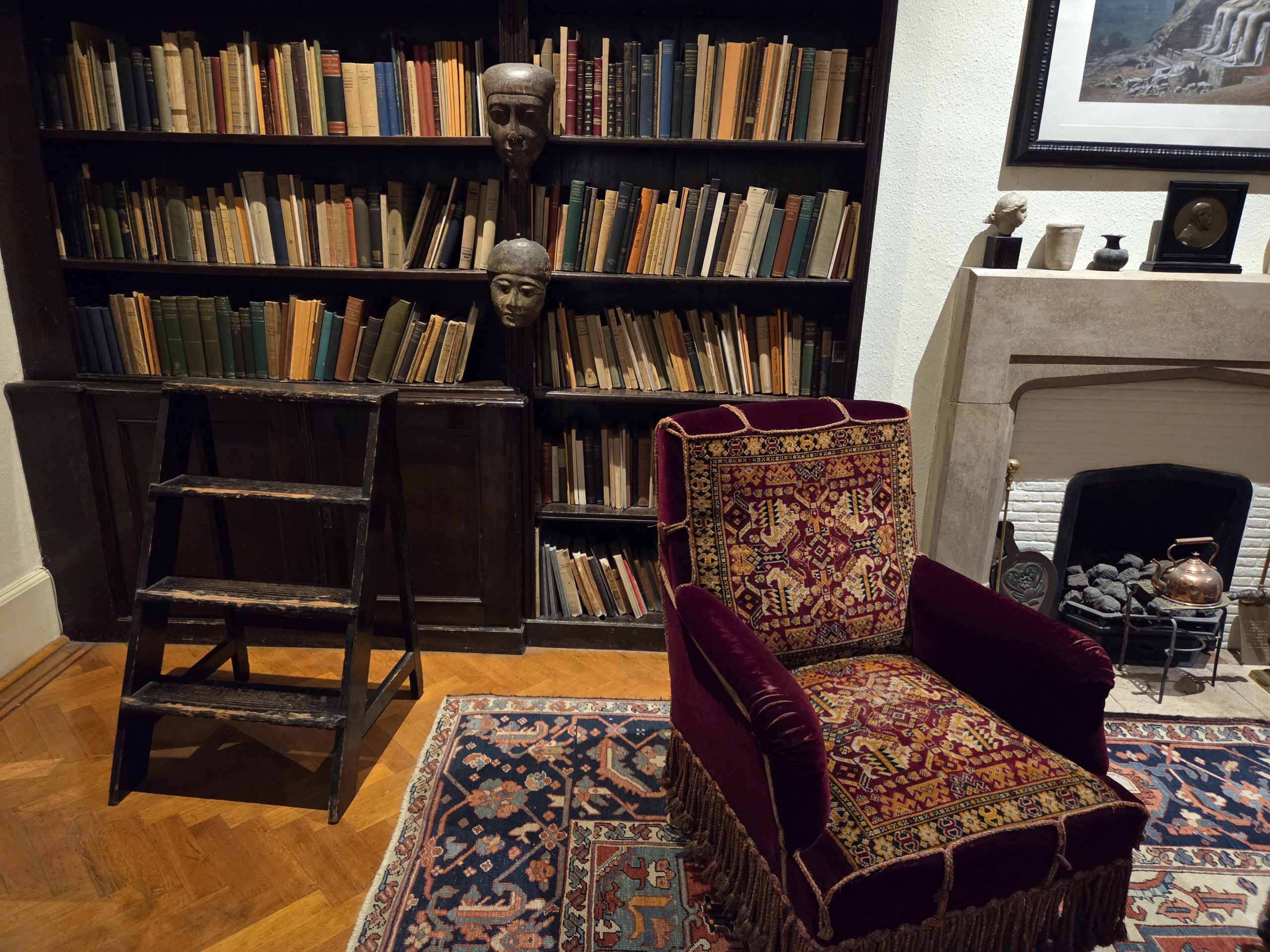
A psychoanalytic treatment often begins before the person can say exactly why they have come.
Something has become difficult to carry. Anxiety returns without an obvious reason. A relationship keeps ending in the same place. A thought will not leave. The body begins to speak through pain, inhibition, sleeplessness, panic, or another symptom. Sometimes nothing dramatic has happened, and yet something no longer holds.
At the beginning, there is suffering.
Someone comes because what they have been able to tell themselves is no longer enough. They may say the problem is a partner, a parent, a loss, work, loneliness, or the past. All of these may be true. Psychoanalysis does not deny reality. But it listens for the point at which suffering exceeds the explanation already available.
The person who knocks on an analyst’s door is not usually asking for psychoanalysis. They are asking for help.
They want relief. They want to understand. Often, they want an answer.
Tell me what this means. Tell me why this is happening. Help me make it stop.
There is already an address to another.
In Lacanian terms, there is demand.
But demand is never only what is explicitly asked. Once something is put into words, one answer calls for another, one explanation opens another question. Something remains unsatisfied.
This is where psychoanalysis begins to make a difference.
Lacan gave particular importance to the preliminary interviews. These are not simply introductory appointments before the “real” treatment begins. They are already part of the work. They are the place where ordinary speech may begin to shift into analytic speech.
A person arrives telling a story. We all do this. We organise events, explain ourselves, try to be coherent, try to be understood.
The analyst listens to the story, but not only to the story.
The analyst listens to the word that returns. The hesitation. The contradiction. The forgotten name. The sentence that suddenly sounds strange once it has been spoken. The thing the person quickly dismisses as irrelevant.
And here the analyst makes a wager:
There is something in speech that the speaker does not entirely know.
There is unconscious knowledge at work.
The analytic invitation is therefore quite simple:
Speak.
Say what comes to mind. Even when it seems stupid, irrelevant, embarrassing, repetitive, or without sense.
Freud called this the fundamental rule of free association. Lacan returned to it because it loosens, at least somewhat, the ordinary rules of conversation—the need to be sensible, polite, consistent, and understood (Lacan, 1953–54/1988).
Free association does not mean simply “talk freely.”
It is work.
One signifier leads to another. A memory brings another scene. A word opens onto a dream. A thought that seems unrelated suddenly becomes important.
And then repetition appears.
The analysand may say:
I have already told you this.
Perhaps.
But why has it returned?
For psychoanalysis, repetition is never simply discarded as unnecessary material. What returns may mark the place of something that has not found another way to be said.
This is also why the analyst does not listen like an ordinary conversational partner.
In everyday life, when someone tells us something painful, we often reassure, explain, advise, sympathise, or say that we understand.
The analyst does not rush to understand.
Sometimes understanding too quickly closes precisely what needs to remain open.
A silence, a question, a cut, or the repetition of one of the person’s own words may make something familiar suddenly unfamiliar.
Lacan’s direction of the treatment depends on this. Analysis is not advice, education, or adaptation to reality (Lacan, 1958/2006). The analyst leaves room for what does not fit neatly into meaning.
This is where the unconscious appears—not as a hidden box somewhere inside the person, but in the breaks, repetitions, slips, and strange insistences of speech.
Lacan also distinguishes between what is said and the act of Saying.
A person may tell the same story many times, but something in the way it is said may shift. Something in the address may change. A word becomes charged. A pause appears. A sentence surprises the person who has just spoken it.
Psychoanalysis listens not only to what someone means to say, but to what happens in the saying itself (Lacan, 1972–73/1998).
And as the person speaks, something else begins.
The analyst becomes part of the address.
This is transference.
The analyst may become the one who is supposed to know.
To know why the person suffers.
To know what the symptom means.
To know what they should do.
Lacan writes that “at the beginning of psychoanalysis is transference” (Lacan, 1967/1995).
But the analyst does not take up this position by saying: Yes, I know who you are.
That would close the work.
The analyst does something more difficult.
They occupy the place where knowledge is supposed, without pretending to possess the final answer.
This allows the person to continue speaking, associating, repeating—and, in time, to encounter the knowledge already at work in their own speech.
Then something begins to shift in the complaint that first brought them.
At first, the person may say:
This is happening to me.
Later, another question can emerge:
What is my place in what keeps happening?
This is not about blame.
It is not saying that someone caused their own suffering.
It is a shift in position.
The symptom begins to become something more than an unwanted disturbance. It becomes an enigma.
Why this symptom?
Why this repetition?
Why this particular kind of suffering?
Why this scene again?
Why this word?
Why this kind of relationship?
The symptom begins to concern the subject.
And this is one of the decisive moments in psychoanalytic work.
The person who first came asking for the symptom to disappear may begin to ask what the symptom has to do with them.
This is where the beginning of analysis already contains something of its direction.
Someone arrives hoping that another person will explain what is wrong.
Psychoanalysis does not rush to provide that explanation.
Instead, it makes a space where suffering can become a question.
Complaint becomes question.
Speech becomes association.
Demand opens onto desire.
Transference gives the work its address.
The symptom begins to show something of the singular logic by which a life has been organised.
A psychoanalytic treatment begins, then, when someone who suffers finds a place where what they say can be heard otherwise.
The first words may be quite ordinary:
I am anxious.
I cannot continue like this.
I do not understand why this keeps happening.
But if the analytic work begins, these words no longer remain exactly where they were.
Something in them starts to move.
Something previously unheard begins to insist.
And from there, analysis begins.
References
Freud, S. (1913). On beginning the treatment (Further recommendations on the technique of psycho-analysis I). In The Standard Edition of the Complete Psychological Works of Sigmund Freud (Vol. 12, pp. 121–144). Hogarth Press.
Lacan, J. (1988). The Seminar of Jacques Lacan, Book I: Freud’s Papers on Technique, 1953–1954 (J.-A. Miller, Ed.; J. Forrester, Trans.). W. W. Norton.
Lacan, J. (2006). The direction of the treatment and the principles of its power. In Écrits: The First Complete Edition in English (B. Fink, Trans., pp. 489–542). W. W. Norton. (Original work published 1958)
Lacan, J. (1995). Proposition of 9 October 1967 on the psychoanalyst of the School (R. Grigg, Trans.). Analysis, 6. (Original work presented 1967)
Lacan, J. (1998). The Seminar of Jacques Lacan, Book XX: Encore: On Feminine Sexuality, the Limits of Love and Knowledge, 1972–1973 (J.-A. Miller, Ed.; B. Fink, Trans.). W. W. Norton.